
Flat and low-slope roofing
Flat roofing repair, maintenance and replacement
A flat roof rarely fails in the middle of the field. It fails at a seam, a penetration, an edge or a drain — and those are findable, fixable problems long before the whole system needs replacing.
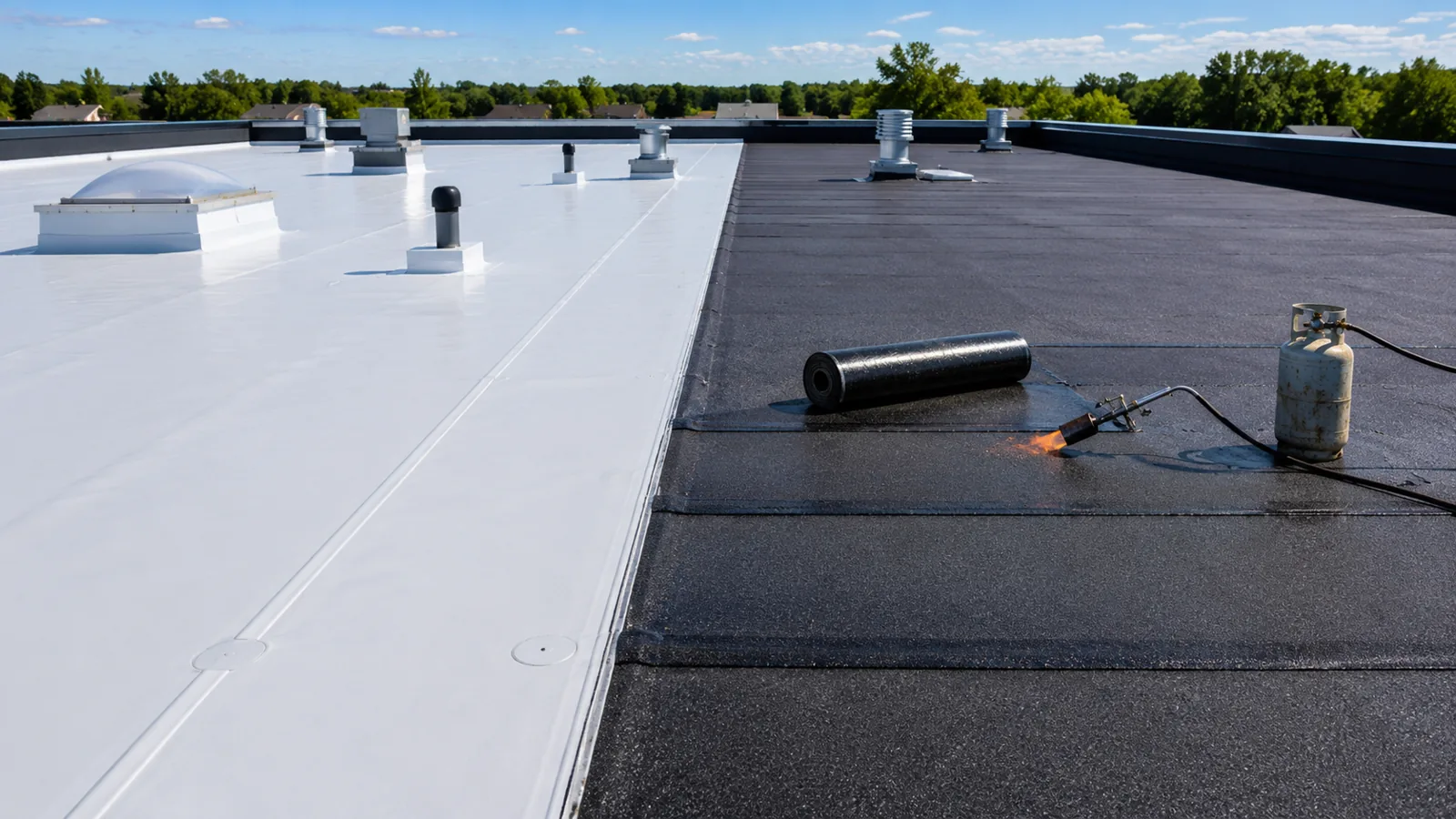
- Torch down, modified bitumen, TPO, EPDM and built-up systems
- Leak tracing on low-slope roofs where water travels far from the entry point
- Residential flat sections, commercial buildings and multifamily decks
Diagnosis first
Low-slope leak tracing is a different discipline
On a steep roof, gravity gives you a head start: water travels roughly downhill from where it entered. On a flat roof it does not. Water can enter at a parapet termination, travel laterally between the membrane and the insulation, and appear inside the building twenty feet away and one floor down.
That is why we start with the details rather than the field. Seams, penetrations, drains, edges, curbs and terminations — inspected in sequence — account for the very large majority of flat roof leaks we find in this region.
Systems we work on
Torch down and modified bitumen remain extremely common on Puget Sound flat roofs. They are durable, they handle our rainfall well, and they are repairable in sections rather than all at once.
Single-ply membranes such as TPO and EPDM are widespread on commercial buildings. Repairs here are about seam integrity, correct patching technique and penetration detailing.
Built-up roofing on older buildings can have decades of service left in it if the gravel surface, flashings and drains are maintained.
Residential flat sections — a flat porch roof, a dormer top, a deck over living space — are frequently the source of leaks in otherwise pitched-roof homes, and they are frequently skipped by contractors who only do steep-slope work.
Repair, restore or replace
Flat roofs offer a middle option that pitched roofs generally do not. When a membrane is aged but fundamentally intact and the insulation beneath is dry, restoration or overlay can add meaningful service life for considerably less than replacement. When the insulation is saturated, that option disappears — wet insulation has to come off.
We will tell you which situation you are in, because it changes the number substantially and you deserve to know why.
Flat roofs across King and Snohomish County
Low-slope work in this region is concentrated in a few recognisable building types. Seattle and Shoreline have older commercial storefronts and mid-century homes with torch down porch and dormer sections. Everett, Lynnwood and Kent carry a large stock of apartment buildings, light-industrial units and warehouses where the leaks start at drains, parapet terminations and rooftop mechanical curbs. Bellevue, Kirkland, Redmond and Bothell add newer townhome and cottage construction with small flat entry and deck sections built over living space.
What all of them share is our rainfall pattern: long stretches of steady, low-intensity rain rather than short storms. That is the worst case for a low-slope roof, because water sits at a failing detail for hours at a time instead of running off. It is also why so many Puget Sound flat roof leaks show up as slow ceiling staining rather than obvious dripping, and why tracing the entry point matters more here than almost anywhere else.
Common failures
Where flat roofs actually let water in
Seams and laps
Penetrations and curbs
Edges, parapets and terminations
Ponding water and failed drainage
Blisters, splits and shrinkage
Foot traffic damage
Water showing up somewhere odd under a flat roof?
That is normal for low-slope systems and it is exactly why tracing matters. Let us find the actual entry point before anyone talks about replacing the membrane.