
Flat roof repair
Flat and low-slope roof repair in Seattle
Low-slope roofs almost never fail in the middle. They fail at seams, penetrations, edges and drains — and those failures are usually repairable long before the membrane itself is finished.
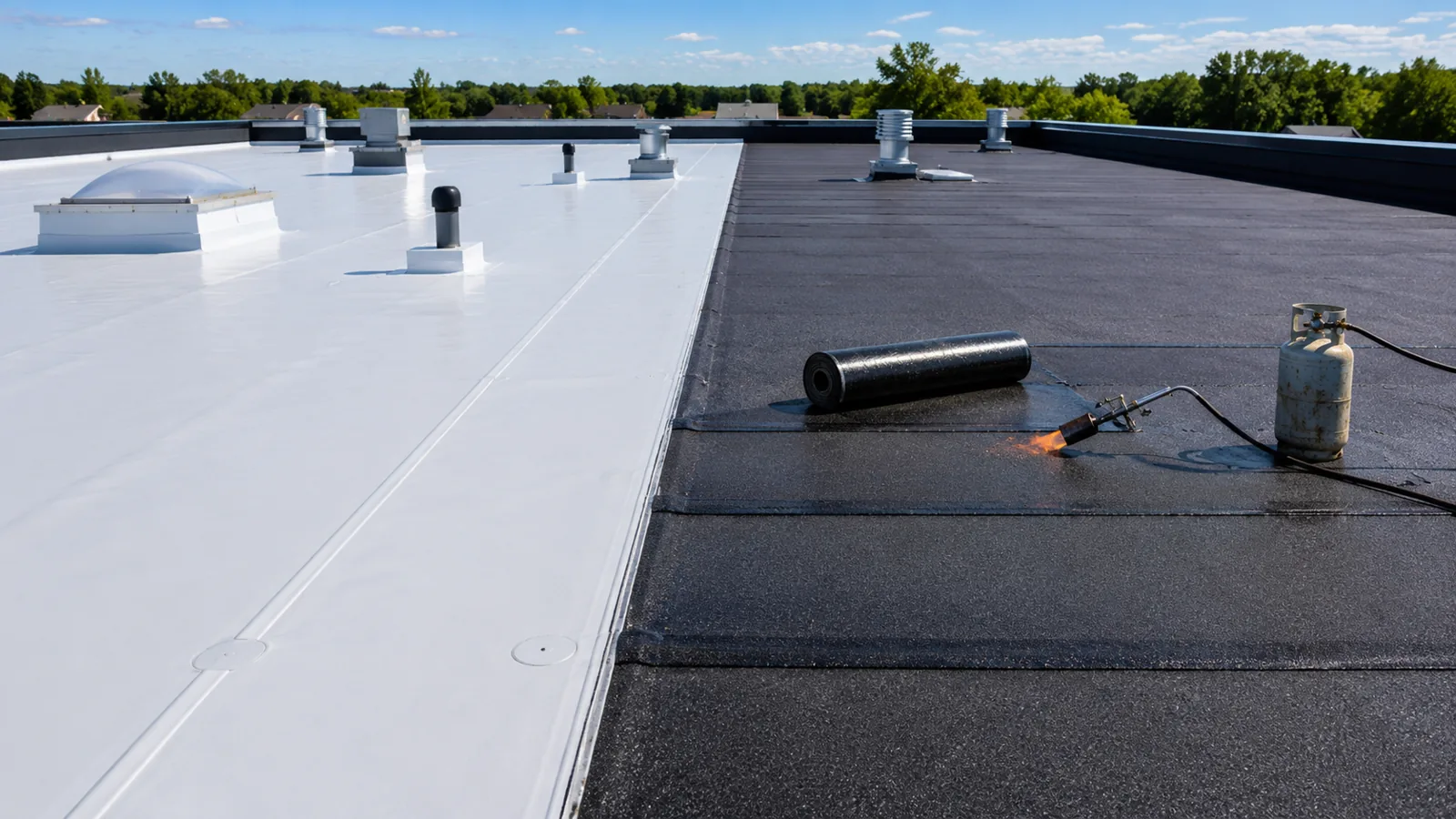
- TPO, PVC, modified bitumen (torch-down) and built-up systems
- Seam, drain, curb, edge metal and penetration repairs
- Residential, apartment and commercial low-slope roofs
Seattle
Diagnosing a low-slope roof is a different discipline
On a steep-slope roof, gravity does most of the work and water leaves quickly. On a low-slope roof, water sits, and anything less than a continuous watertight surface eventually lets it through. That changes what you look at: seams and laps, flashing at parapets and curbs, drain bowls and clamping rings, edge metal, and every pipe, vent and equipment penetration.
It also changes how leaks present. Water entering at a parapet can travel between layers of insulation and appear inside a building a long distance from the actual breach. Chasing the interior stain on a flat roof is how people end up paying for three repairs that did not fix anything.
Seattle has an enormous amount of low-slope roofing: flat-roofed modern homes, mid-century additions and carports, apartment buildings across Capitol Hill, the University District and Rainier Valley, and commercial and mixed-use buildings throughout the city. Many of them are on membranes with real service life left that are leaking at a single failed detail.
We repair when the system can still deliver, maintain it when that extends its life economically, and recommend replacement only when the evidence supports it — with photographs, not assertions.
Related services
- Flat and low-slope roofing
- Commercial and multifamily roofing
- Roof maintenance and asset management
- All roofing services in Seattle
Licensed, bonded and insured. Washington contractor registration ROOFISN776BC, held by Remodeling Solutions Northwest, LLC. Call (425) 741-3744 if water is coming in now.
How it works
How we approach a flat roof leak
1. Identify the system
TPO, PVC, modified bitumen and built-up roofs each fail differently and need different repairs.
2. Survey the details
Seams, laps, curbs, parapets, edge metal, drains and penetrations get checked before the field.
3. Check the drains
Blocked drains and crushed insulation cause ponding that magnifies every other defect.
4. Probe for wet insulation
Saturated insulation tells us whether this is a local repair or a wider replacement question.
5. Repair in kind
Repairs are made with materials compatible with the existing membrane, not whatever is on the truck.
6. Document and plan
For owners and managers, findings are photographed and prioritized for budgeting.
Questions
Common questions
- Can a flat roof be repaired, or does it have to be replaced?
- Most low-slope leaks are seam, penetration, edge or drain failures and are repairable. Replacement makes sense when the membrane has lost its plasticizers, the insulation is saturated across large areas, or the same system keeps failing in new places.
- What causes ponding water and does it matter?
- Ponding comes from blocked drains, crushed or wet insulation, and deck deflection. It matters because standing water accelerates every other failure and adds weight, though the water itself is not the leak.
- Do you work on torch-down and single-ply?
- Yes. We repair and install modified bitumen (torch-down), TPO, PVC and built-up systems, and we match repairs to the existing membrane rather than patching one system with another.
- Can you handle apartment and commercial buildings?
- Yes. For owners and property managers we document conditions across the whole property and sequence repairs by urgency so budgets can be planned across years.
Not sure whether you need a repair or a replacement?
That is exactly the question we answer. Send us the details and we will tell you what the roof actually needs — including when the answer is that it needs very little.